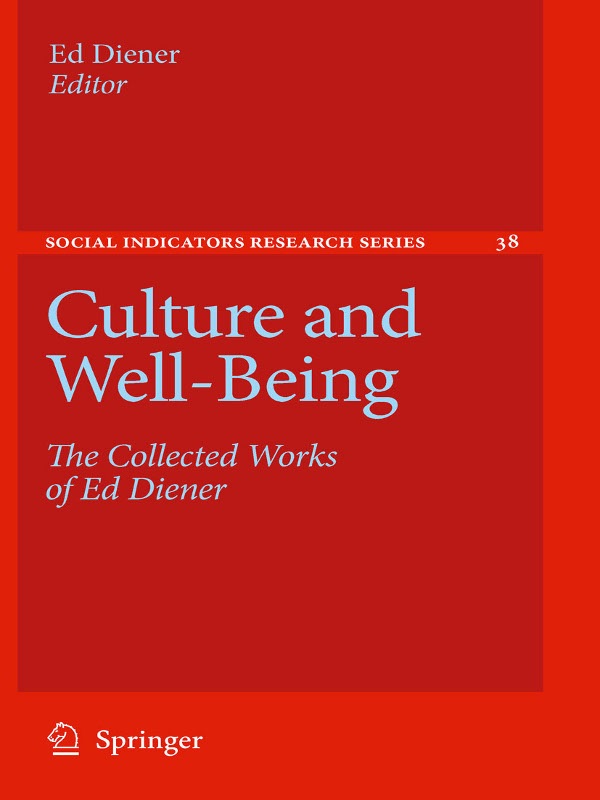
FOUNDATIONAL THESIS
Human happiness is not a monolithic global experience; it is deeply rooted in the soil of local culture.
Ed Diener's monumental research proves that what makes a person thrive in New York may leave them isolated in Tokyo.
Culture acts as the invisible operating system that dictates how individuals evaluate their lives, express their emotions, and pursue fulfillment.
Mastering these cross-cultural dynamics allows us to decode the true drivers of human well-being beyond mere economic indicators.
The Architecture of Subjective Well-Being
Subjective Well-Being (SWB) is composed of distinct cognitive judgments of life satisfaction and emotional experiences of positive and negative affect.
These components operate independently across different cultural landscapes.
Happiness is not merely the absence of pain, but the cognitive endorsement of one's life conditions filtered through cultural lenses.
People in different societies weigh various life domains differently when calculating their overall global life satisfaction.
To understand a population, we must measure both emotional frequency and cognitive evaluation while respecting local semantic interpretations of 'happiness.'
Subjective well-being serves as the ultimate metric of human success.
- Cognitive Evaluation: Measure life satisfaction using culturally validated scales rather than assumed universal standards.
- Affect Balance: Track the ratio of positive to negative emotional experiences over time.
- Domain Weighting: Identify which specific life areas—health, wealth, or relationships—drive local satisfaction.
Individualism, Collectivism, and the Self
Individualistic cultures prioritize personal autonomy, self-expression, and internal emotional states as primary drivers of life satisfaction.
Collectivist cultures emphasize social harmony, role fulfillment, and interpersonal obligations.
The independent self finds joy in personal achievement, while the interdependent self thrives in relational alignment.
When self-esteem aligns with cultural values, subjective well-being skyrockets regardless of economic status.
Leaders must recognize that imposing individualistic motivational frameworks onto collectivist teams will trigger severe disengagement.
Cultural self-construal dictates the very source of human motivation and reward.
- Autonomy Alignment: Match reward structures with the prevailing individualistic or collectivist orientation of the group.
- Harmonic Metrics: Evaluate team success through relational cohesion in collectivist environments.
- Personal Efficacy: Foster individual agency primarily in settings that celebrate personal distinction.
Wealth, Income, and the Material Paradox
Economic prosperity lifts nations out of misery, but beyond a certain threshold of basic needs fulfillment, additional wealth yields diminishing returns on happiness.
Money buys freedom from survival stress, but it cannot purchase the social capital that sustains long-term joy.
Materialistic aspirations consistently correlate with lower overall life satisfaction across diverse national samples.
Societies that hyper-focus on GDP growth often neglect the relational infrastructure required to maintain high collective well-being.
Economic utility is entirely moderated by societal expectations and relative deprivation.
- Threshold Analysis: Identify the point of diminishing returns for financial incentives within your specific demographic.
- Materialism Audit: Minimize status-driven consumption pressures inside organizational cultures.
- Resource Allocation: Redirect capital investments from purely material perks toward community-building initiatives.
Emotion Display Rules and Cultural Expression
Cultures prescribe strict rules regarding which emotions can be publicly displayed and how intensely they should be communicated.
Smiling is universally recognized as a sign of friendliness, yet its social frequency and meaning vary dramatically across borders.
Nations with high scores in extraversion and low uncertainty avoidance encourage open emotional expression and frequent smiling.
Misinterpreting these display rules leads to erroneous cross-cultural judgments about leadership competence and emotional stability.
Display rules govern the social translation of internal emotional states.
- Expression Calibration: Adjust your interpretation of emotional feedback based on local display norms.
- Feedback Channels: Create psychological safety mechanisms for reserved cultures to share critical insights.
- Affective Mapping: Distinguish between internal happiness and culturally mandated outward cheerfulness.
Social Relationships and the Universal Human Need
Across virtually every studied culture, strong social relationships and supportive networks emerge as the single strongest predictor of high subjective well-being.
Humans are obligate social creatures whose neurological wiring demands deep tribal connection to thrive.
The presence of trusted confidants buffers against extreme life stress regardless of whether the culture is individualist or collectivist.
Isolation is a universal toxin that degrades both mental health and physiological longevity.
Relational capital outperforms financial capital as a predictor of resilient human thriving.
- Network Density: Cultivate deep, high-trust relational circles rather than sprawling superficial contacts.
- Support Systems: Design institutional safety nets that guarantee access to reliable interpersonal support.
- Community Rituals: Establish regular relational touchpoints to reinforce tribal cohesion and psychological safety.
Societal Institutions, Governance, and Trust
Fairness, low corruption, political freedom, and institutional trust powerfully elevate national well-being by reducing ambient existential anxiety.
Trust in public institutions is the invisible scaffolding that allows citizens to take risks and pursue meaningful lives.
When citizens believe their government and legal systems are fair and predictable, their baseline life satisfaction surges.
Societal dysfunction destroys well-being by forcing individuals into constant hyper-vigilance and survival defensiveness.
Institutional integrity directly translates into the psychological peace of the populace.
- Transparency Protocols: Establish rigorous fairness and clarity in organizational and societal governance.
- Trust Architecture: Eliminate arbitrary rule enforcement to reduce systemic anxiety and friction.
- Civic Engagement: Involve stakeholders directly in rule-making to maximize perceived procedural justice.
The Pitfalls of Universalizing Happiness Metrics
Applying Western psychometric tools globally without adaptation leads to severe data distortion and misguided policy interventions.
Ethnocentrism in psychology mistakes Western cultural preferences for universal human laws.
True scientific rigor requires indigenous psychologies that capture local nuances unrepresented in standard global surveys.
Global leaders must resist the temptation to implement standardized, one-size-fits-all well-being programs across diverse international subsidiaries.
Universal metrics must be validated against indigenous definitions of the good life.
- Contextual Validation: Test all diagnostic tools against local cultural norms before widespread deployment.
- Indigenous Integration: Incorporate local wisdom traditions and vernacular concepts into psychological assessments.
- Bias Mitigation: Train evaluators to spot their own ethnocentric assumptions when reviewing cross-cultural data.
Designing Cultures for Human Flourishing
We possess the empirical data required to intentionally architect cultures that maximize both performance and sustainable well-being.
Culture is not an accidental byproduct of history; it is a design variable that we can shape with scientific precision.
Optimizing an environment requires balancing economic security, relational depth, and respect for local autonomy.
Leaders who master these principles can engineer high-trust ecosystems where human potential is fully unlocked.
Deliberate cultural architecture is the ultimate competitive advantage of the 21st century.
- Ecosystem Audit: Evaluate your organization's cultural alignment with the psychological needs of its members.
- Holistic KPI Design: Balance performance metrics with measures of relational health and trust.
- Iterative Refinement: Treat culture as an evolving operating system subject to continuous empirical feedback.
Executive Synthesis & Monday Morning Action
Ed Diener's life work demonstrates that human happiness is a complex equation balancing universal human needs with localized cultural expressions.
While financial stability and strong social relationships provide the baseline ingredients for survival and joy, culture determines the recipe.
By abandoning ethnocentric biases and respecting indigenous pathways to fulfillment, we unlock the true science of well-being.
Ultimately, designing high-performing cultures requires aligning institutional systems with the deeply ingrained psychological architecture of the people they serve.


