FOUNDATIONAL THESIS
We pride ourselves on being rational thinkers who make logical, calculated decisions.
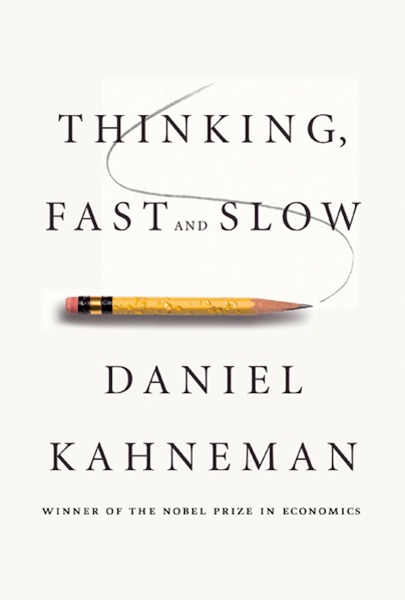
Nobel laureate Daniel Kahneman's Thinking, Fast and Slow shatters this illusion, revealing the hidden cognitive machinery that drives human behavior.
By diagnosing the cognitive biases of System 1 and learning when to activate System 2, you make vastly superior investments, strategic decisions, and life choices.
Two Systems: Fast Intuition vs. Slow Logic
You assume that your conscious, logical mind makes all your daily decisions.
The brain operates through two distinct cognitive systems: System 1 is fast, automatic, emotional, and unconscious. System 2 is slow, effortful, deliberate, and logical.
System 1 detects anger in a voice, dodges an obstacle, and reads billboards instantly without effort.
System 2 calculates 17 x 24, parks in a tight space, and compares complex contract terms.
System 2 is lazy: it seeks to conserve energy and naturally endorses the fast, biased impressions of System 1.
Recognize the interplay of your two minds:
- System 1 runs continuously in the background, creating intuitive impressions.
- System 2 only activates when a problem exceeds System 1's automatic rules.
- Cognitive strain (activating System 2) slows down thinking but dramatically improves accuracy.
- High cognitive load or physical fatigue makes you default to biased System 1 thinking.
Awareness of both systems is the essential first step to overcoming cognitive errors.
WYSIATI: What You See Is All There Is
You hear a brief rumor or single data point and immediately form a definitive opinion.
System 1 is a machine for jumping to conclusions. It operates on the principle of WYSIATI: What You See Is All There Is. It constructs the best possible story from available data and completely ignores missing evidence.
Consistency and coherence of a story matter far more to System 1 than the completeness of the facts.
Confidence is determined by the coherence of the story you tell, not by the quality or quantity of the evidence.
Combat WYSIATI in your decision-making:
- Always ask: 'What critical information am I currently missing?'
- Actively search for disconfirming evidence before finalizing strategic plans.
- Distinguish between compelling narrative coherence and genuine empirical statistical validity.
- Recognize that extreme confidence is often a diagnostic symptom of having very little information.
Looking beyond visible data prevents catastrophic, overconfident blunders.
Heuristics and Biases: Anchoring & Availability
You believe that you estimate values, probabilities, and risks objectively.
When faced with a difficult question, System 1 substitutes an easier heuristic question without you noticing.
Two of the most powerful cognitive heuristics:
- The Anchoring Effect: Exposure to an arbitrary initial number heavily anchors your subsequent estimates (e.g. negotiation baselines, real estate prices).
- The Availability Heuristic: You estimate the frequency of an event by how easily concrete examples come to mind (e.g. plane crashes seem common because they get intense news coverage).
Your intuition consistently confuses ease of recall with statistical probability.
Neutralize heuristics with structured thinking:
- In negotiations, never accept the other party's opening anchor; reset the baseline immediately.
- Base risk assessments on historical base rates and actuarial tables, not vivid news headlines.
- Be conscious of how recent vivid emotional events skew your daily risk tolerance.
- Use checklists to prevent intuitive substitution errors.
Rigorous debiasing anchors your decisions in objective reality.
The Illusion of Understanding and Overconfidence
After a major historical event or market crash occurs, you feel like it was obvious all along.
Hindsight Bias makes us rewrite the history of our minds. When an outcome occurs, we immediately exaggerate the probability with which we believed it would happen.
This creates the Illusion of Validity: experts believe they can predict the future despite decades of empirical evidence proving their predictions are no better than dart-throwing chimpanzees.
We tend to be overconfident in what we believe we know, and unable to acknowledge the full extent of our ignorance.
Protect your strategy from overconfidence:
- Maintain a Decision Journal: record your exact predictions and reasoning before an event happens.
- Conduct a Premortem: assume a project has failed spectacularly 12 months from now, and write the history of why.
- Prefer simple algorithmic checklists over intuitive expert clinical judgment.
- Embrace intellectual humility and probabilistic thinking.
Acknowledging uncertainty builds robust, antifragile strategies.
Prospect Theory & Loss Aversion
You are offered a coin flip: heads you win $150, tails you lose $100. Most people reject the bet.
Prospect Theory (which earned Kahneman the Nobel Prize) proves that human decisions are evaluated based on gains and losses relative to a reference point, not total wealth. Loss Aversion means losses loom roughly twice as large as equivalent gains.
The pain of losing $100 requires a potential gain of $200–$250 to feel psychologically acceptable.
Loss Aversion makes people take foolish, desperate risks to avoid locking in a loss.
Master the psychology of risk:
- Recognize when fear of loss is preventing you from taking high-expected-value asymmetric bets.
- Notice the Sunk Cost Fallacy: holding onto losing stocks or failing projects just to avoid realizing the loss.
- Frame decisions in broad portfolios rather than viewing every individual decision in isolation.
- Reset your mental reference point to current reality rather than past peak valuations.
Overcoming loss aversion unlocks rational, long-term wealth compounding.
Framing Effects: The Power of Context
A doctor tells you: 'This surgery has a 90% survival rate.' Another doctor says: 'This surgery has a 10% mortality rate.'
Even though both statements are mathematically identical, the survival frame makes patients feel confident, while the mortality frame triggers panic.
System 1 is passive and easily influenced by how information is framed.
You cannot escape framing, but you can deliberately reframe problems to reveal hidden truths.
Master the art of reframing:
- Invert the frame: whenever presented with a percentage of success, always calculate the percentage of failure.
- Reframe costs as daily investments vs. massive annual liabilities to evaluate true value.
- Beware of opt-in vs. opt-out default frames in policy and software design.
- Challenge emotional rhetoric by translating statements into neutral mathematical terms.
Deliberate reframing protects you from psychological manipulation.
The Two Selves: Experiencing vs. Remembering
You evaluate a 2-week vacation based on how it felt every single day.
You have two selves: The Experiencing Self (which lives in the present moment, second by second) and The Remembering Self (which keeps score, tells stories, and makes all future decisions).
The Remembering Self does not care about duration; it evaluates an experience based on the Peak-End Rule—the most intense moment and the final ending.
A 30-minute painful procedure with a mild finish is remembered as less painful than a 10-minute procedure that ends sharply.
Apply the Peak-End Rule to design exceptional experiences:
- In relationships and hospitality, focus on creating spectacular peak moments and memorable endings.
- Recognize that the stories you remember dictate your life satisfaction, not the continuous stream of seconds.
- End workdays, presentations, and vacations on a high, delightful note.
- Be conscious of how memory rewrites past experiences.
Understanding your two selves allows you to design a genuinely fulfilling life.
Applied Decision Architecture: Thinking Like a Statistician
Knowing about cognitive biases does not make you immune to them.
Organizations are much better suited to debiasing than individuals because organizations can build structured decision processes that force System 2 analysis.
Design an institutional decision architecture:
- Adopt the Outside View: Base project estimates on statistical base rates of similar past projects rather than optimistic internal forecasts.
- Run Premortems: Encourage candid dissent by asking teams to analyze failure before launch.
- Decouple Independent Evaluations: In interviews and meetings, collect independent individual assessments before group discussions to prevent anchoring. 4. Use Checklist Protocols: Standardize complex judgment calls to reduce random noise.
Systematic decision architecture institutionalizes rational, world-class judgment.
The Brain's Secret Battle: Why This Book Is a Masterpiece Most People Miss
Millions of readers pick up "Thinking, Fast and Slow" hoping for a magic key to better decisions. They want to outsmart their own minds, make smarter choices at work, and avoid costly mistakes. But does this thick book really deliver on that promise for busy, everyday people?
When "Thinking, Fast and Slow" first hit the shelves, the buzz was electric. Millions of working professionals and curious minds hoped it would unlock the secrets to perfect decision-making. We all wanted to be smarter, to avoid those dumb mistakes we keep making. This book promised to show us how our own brains were secretly sabotaging us.
But then you open it. The pages are packed. It's not a breezy read; it's a deep dive into decades of research. Busy managers and people trying to get in shape often found themselves slogging through academic studies, feeling like they needed a PhD just to keep up. The initial excitement could quickly turn into a feeling of being overwhelmed.
Yet, if you pushed through, a powerful idea emerged: the two systems. Your quick, gut-feeling System 1 and your slow, logical System 2. This simple distinction suddenly made sense of so much. It was like getting a secret decoder ring for your own thoughts. You started to see why you sometimes acted on impulse and other times carefully weighed options.
Then came the parade of biases. Anchoring, availability, confirmation bias – suddenly, you had names for all those predictable mistakes. You began to notice them everywhere: in news headlines, in sales pitches, even in your own head. This wasn't just theory; it was a new lens for seeing the world. It didn't make you perfect, but it made you aware.
The book is a challenge, no doubt. It demands your attention, your patience. But for those who stick with it, the reward is a profound understanding of the human mind. It's not about becoming a robot, but about recognizing the powerful, often hidden forces that shape our choices every single day.
The Honest Verdict
You are fascinated by how the human mind works, enjoy deep dives into psychology, and are willing to put in the effort to truly understand the roots of irrationality.
You're looking for a light, easy read with immediate, actionable tips for everyday decision-making without much mental heavy lifting.
Apply The 20% That Actually Works
Don't get bogged down in hundreds of pages. Master the full executive framework in 15 minutes, or open the 1-page action worksheet directly.
-
Offers a more accessible and entertaining look at human irrationality with relatable experiments and stories.
-
Focuses more on how understanding human biases can be used to "nudge" people towards better decisions, often with practical applications.
-
Provides a practical framework for making better decisions in uncertain situations, drawing on poker and real-world examples.
Executive Synthesis & Monday Morning Action
Human thinking is governed by the dance between fast, intuitive System 1 and slow, logical System 2.
By recognizing cognitive biases like WYSIATI, anchoring, loss aversion, and the Peak-End Rule, and by instituting structured decision architectures, you elevate your strategic judgment to elite levels.


